
Lifelong Exercise Is the Price of Staying Independent as We Age
What if the strength and clarity we assume will always be there quietly erode as we postpone exercise until it feels necessary?
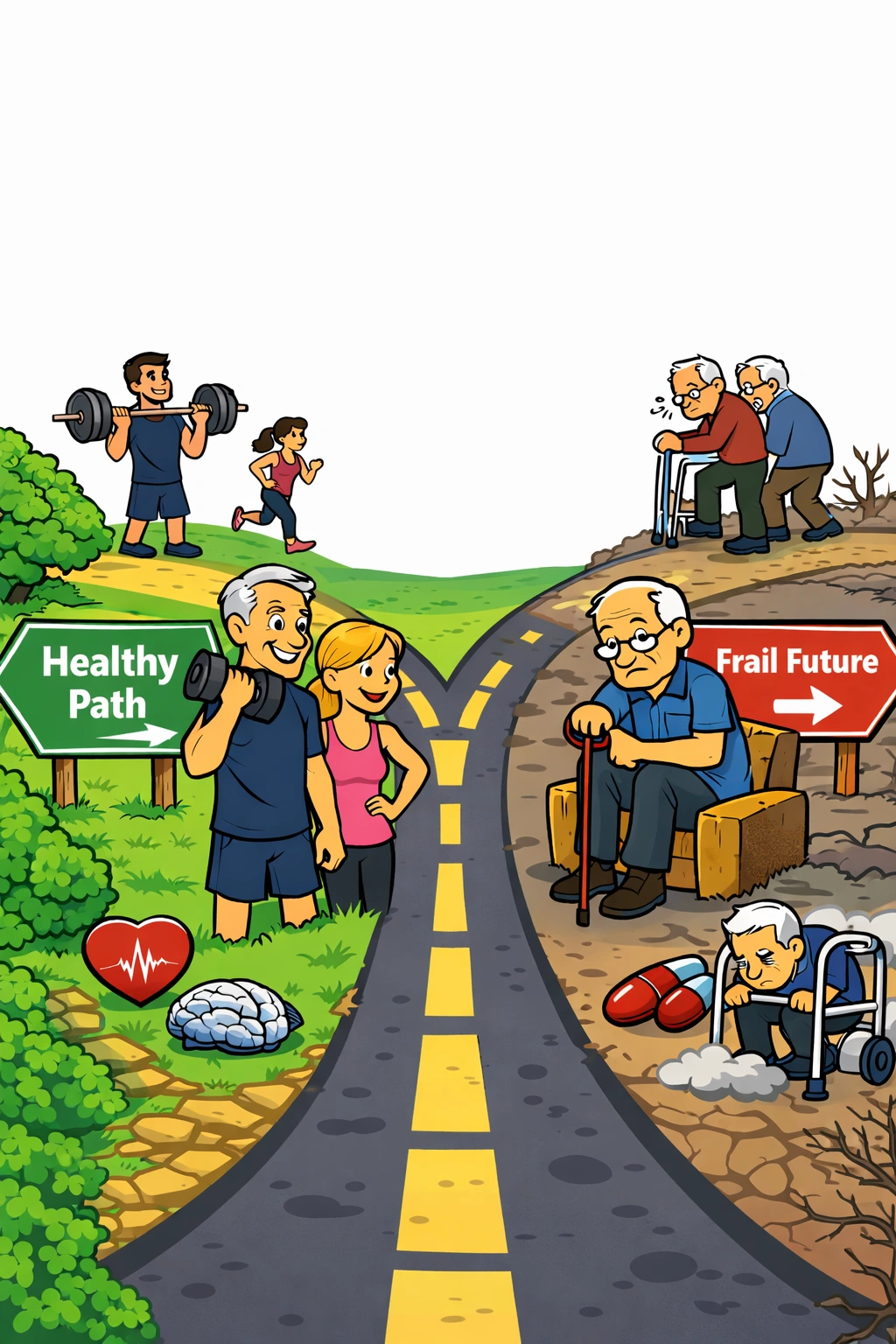
In early and middle adulthood, strength feels stable, balance feels automatic, and recovery feels quick. Exercise is often pushed behind work, family, and convenience because nothing appears urgent. Years pass with irregular training, mostly light movement, and long stretches of sitting. Gradually, muscle narrows, stamina declines, joints stiffen, and mental sharpness becomes less reliable. Loss of muscle and structural strength compounds with age, and the lower the starting capacity, the sooner that loss becomes visible in daily life.
The solution is a lifelong structure that deliberately includes regular intense exercise. Resistance performed with meaningful load preserves muscle and bone. Periods of higher effort maintain cardiovascular and metabolic capacity. Mobility and balance work protect joint range and coordination. The higher the capacity built and maintained over decades, the slower decline becomes noticeable, and the longer independence remains intact. |
Try This
|
 |
These actions are not about fitness goals. They are structural investments. When strength, intensity, mobility, and consistency are built into each week, capacity compounds instead of shrinking. You keep the ability to move, think, and function on your own terms.
Why It Matters
- Regular strength training preserves muscle reserve, keeping lifting, climbing, and carrying manageable across decades.
- Consistent cardiovascular effort expands endurance, supporting travel, recreation, and sustained daily energy.
- Balance and coordination practice maintain stability and confidence in movement.
- Full range joint training protects posture and mobility as the years advance.
- Higher physical capacity allows everyday tasks to remain self-directed rather than assisted.
- Ongoing exercise supports clearer thinking, steadier mood, and more reliable mental focus.
What Not to Do
- Do not assume feeling young today guarantees strength and stamina tomorrow.
- Do not let comfort become the default if you expect strength in the future.
- Do not rely only on low effort activity to preserve muscle and structure.
- Do not focus exclusively on cardio while neglecting resistance training.
- Do not train only one region of the body while ignoring others.
- Do not wait for visible decline before taking exercise seriously.
Bottom Line
Aging does not remove capacity at random. It reduces what is not reinforced. When exercise is postponed in youth and diluted in midlife, muscle shrinks, stamina narrows, balance weakens, and clarity softens. When training is consistent and intense enough to challenge strength, heart, and coordination, capacity compounds instead of eroding. Lifelong exercise is not about appearance or trends. It is about preserving function across decades.
In Embracing My Vitality, physical capacity is treated as infrastructure that must be reinforced continuously rather than repaired after decline. Resistance, cardiovascular effort, mobility, balance, and consistency form a structure that protects independence and mental sharpness over time. The direction you train across decades becomes the direction you age.